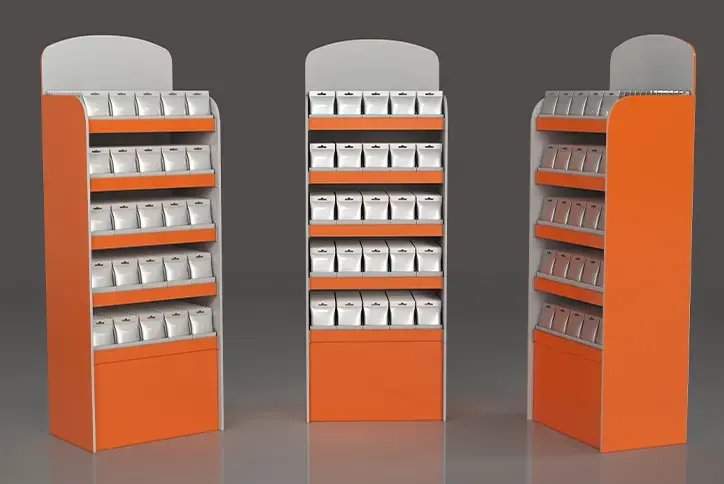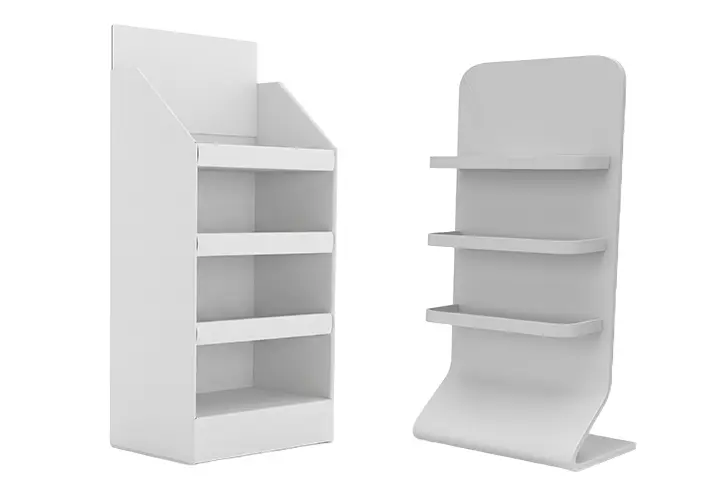
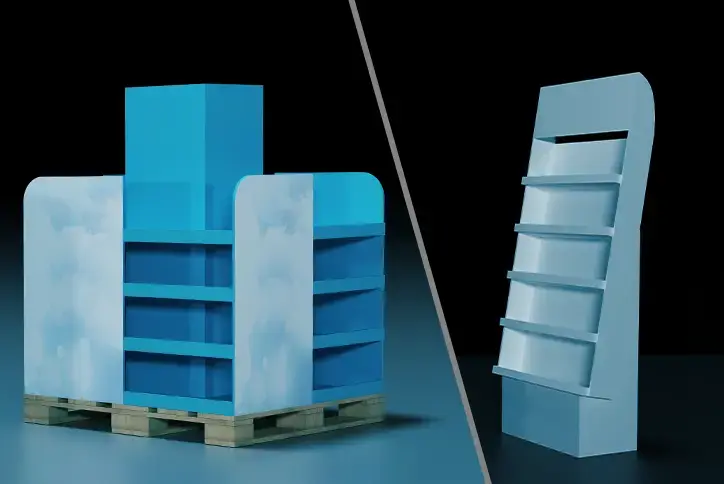
Retail displays effectively increase sales, drive impulse buying, and improve brand recall. Two common corrugated types, floor and pallet displays, put products within reach as customers walk the retail floor. While they share similarities, each serves a distinct function. Understanding them will help marketers choose the best display for their product and goals.
Pallet Displays Are Built Around Volume
Custom corrugated pallet displays can be pre-loaded for immediate floor placement. Because they are built on a pallet, they go straight from the truck to the floor without assembly or product loading. Many retailers prefer this method, but they can also be shipped knocked down flat (KDF) when permitted.
Consumers usually shop pallet displays at high-volume retailers, big box stores, and warehouse clubs, which generally have pallet display specifications. They can be configured in many ways, including full-pallet, half-pallet, or quarter-pallet; with or without shelves; for one or a combination of products; and with access from 2, 3 or 4 sides.
Choosing the pallet depends largely on the retailer’s requirements. Retailer specifications affect more than size. They may govern pallet type, maximum height and weight, overhang, signage, barcode placement, material use, and testing documentation. Failure to meet the requirements could result in product being rejected or additional fees or chargebacks being assessed.
For example, Sam’s Club requires that a certain number of sides be shoppable, that products face a specific direction, and that pallets meet requirements for footprint, dimensions, weight, and overhang. Displays must also arrive club-ready with minimal store setup, and products must remain stable during shipping using approved trays, dividers, supports, or other containment. Packaging must also withstand required compression, vibration, and handling tests. Its guidelines include specific design styles and requirements for different product types, such as boxes, produce, and blister cards, as well as options like containment trays, stacking trays, dividers, and bulk bins.
Floor Displays are Built For Flexibility
Floor displays use a smaller footprint than pallet displays, which gives retailers more placement options. They can be positioned in aisles, near checkout areas, at store entrances, or within a department where a full pallet would take up too much space. This format works well for targeted promotions, product launches, seasonal campaigns, and products that do not require pallet-scale inventory.
Unlike prepacked pallet displays, corrugated floor displays are often shipped knocked down flat, then assembled and stocked at the store. Flat shipping can reduce freight and storage space, but it adds store labor and makes clear assembly instructions important. Prepacked floor displays are another option when the structure and distribution process can protect the display and product through transit.
The display structure must match the product load, shelf arrangement, expected replenishment, and length of the promotion. Heavier products may require reinforced shelves, trays, or internal supports, while lighter products allow more freedom in shape and graphics. Headers, side panels, shelf fronts, and die-cut components can provide branding and product information without increasing the floor space.
Retailer requirements still apply. Floor displays may need to meet limits for height, width, stability, aisle clearance, materials, and placement, and the retailer may restrict where or how long they can remain on the sales floor. Compared with pallet displays, they hold less inventory and may require more frequent restocking, but their smaller footprint and larger graphic area relative to product capacity make them useful when placement and visual presentation carry more weight than bulk volume.
Side-by-Side Comparison: Pallet Display vs. Floor Displays
| Comparison Point | Pallet Displays | Floor Displays |
|---|---|---|
| Basic structure | Product and display components are supported by a pallet base. | Freestanding display placed directly on the retail floor. |
| Typical product volume | Holds larger quantities of product, including bulk packs and multipacks. Can hold more than one product. | Usually holds less inventory but can organize products across shelves, trays, hooks or compartments. |
| Footprint | Usually follows full-, half- or quarter-pallet dimensions. | Can be designed around the space available rather than a standard pallet footprint. |
| Retail environments | Common in warehouse clubs, big-box stores and other high-volume retail formats. | Common in supermarkets, specialty stores, promotional areas and stores with tighter floor-space limits. |
| Placement | Often placed in action alleys, entrances and large promotional zones with adequate clearance. | Can fit beside aisles, near departments, in promotional zones or adjacent to endcaps. |
| Shipping and handling | Can fit pallet-based distribution and material-handling systems. Some units may arrive loaded or partly assembled. | Often ships flat and is assembled and stocked in the store, but can be shipped fully assembled. |
| Store setup | Can reduce handling when the display moves from distribution to the sales floor as one unit. | Setup requirements depend on the structure and may include assembly, positioning, and manual stocking. |
| Replenishment | Works well when replenishment follows pallet, case-pack or bulk-product quantities. | Often requires store employees to refill shelves, trays or hooks manually. |
| Design flexibility | Can use shelves, trays, dividers and headers, but the pallet footprint, product load and shipping requirements place tighter limits on the overall form. | Can take on more creative shapes and structures, including product-specific contours, dimensional elements and themed forms that reinforce the campaign. |
| Graphic area | Provides branding surfaces, but product volume and structural requirements can limit the format. | Allows more freedom in shape, printed surfaces, headers and product presentation. |
| SKU organization | Often used for one product or a limited number of related SKUs in larger quantities. | Can separate and present several SKUs within one display. |
| Space efficiency | Places substantial inventory within one defined footprint but requires enough open floor area. | Can be sized for narrower or irregular merchandising spaces. |
| Freight considerations | Pallet compatibility can simplify bulk movement, but the assembled display may consume more freight and storage space. | Flat-packed units can reduce shipping and storage volume, although they shift more setup work to the store. |
| Strongest use case | High-volume programs involving heavy products, bulk packs or pallet-based replenishment. | Product launches, seasonal promotions, mixed-SKU programs and campaigns that need more control over presentation. |
| Primary limitation | Less flexibility in footprint and placement. A partially depleted pallet can also expose empty space quickly. | Lower product capacity and potentially greater assembly or replenishment labor. |
Develop Your Retail Display With Atlas Packaging
Atlas Packaging and Displays will design and manufacture custom corrugated displays to meet your specific needs. Our in-house design team can develop pallet and floor display structures, produce prototypes for review, and combine the finished structure with printed graphics suited to the retail program.
We also provide assembly and fulfillment support for programs that need displays packed with product and prepared for distribution. Whether the display must ship flat for store assembly or arrive prepacked and ready for placement, we can account for those requirements before production begins.