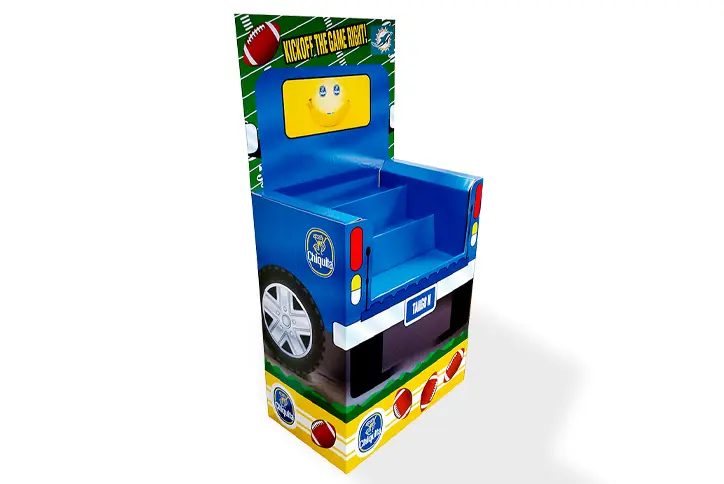
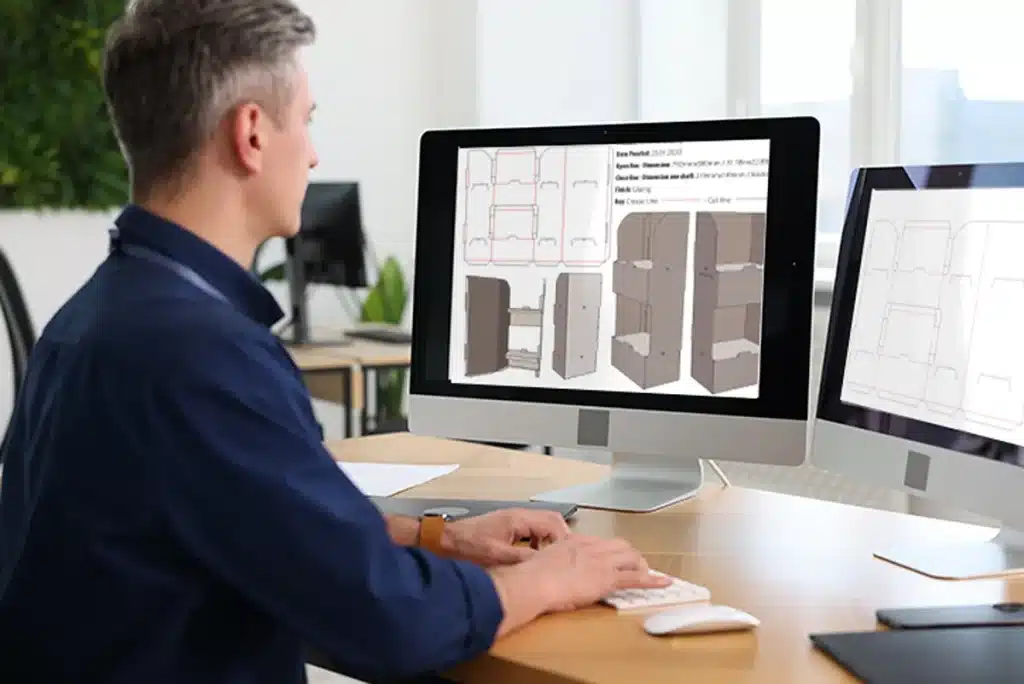
Retail display programs are often evaluated based on appearance, branding, and shopper engagement. While those factors are important, the display’s structural design largely determines the cost of producing and deploying a program. Decisions made about corrugated display design will affect manufacturing, freight, fulfillment, assembly, replenishment, and even display failure rates. For companies managing retail programs across multiple locations, small engineering decisions can affect thousands of displays. Understanding where costs originate allows companies to make smarter decisions before production begins.
Material and Manufacturing Costs
The most obvious expenses in a display program are materials and manufacturing. However, how efficiently it is engineered will have the largest impact on cost. Decisions on board grades, components, complexity, and board utilization all directly impact costs.
Board grade selection is a critical decision. The selection should be based on product weight, display life expectancy, graphic display, retailer requirements, and environmental conditions. As a result, some corrugated displays use more than one board grade or flute profile because different parts of the display have different functions. Finer flute profiles can provide a smoother surface for printed graphics and branded panels, but they may not provide enough strength for shelves, load-bearing supports, or areas exposed to repeated handling. Heavier grades or stronger flute profiles may be needed in those structural areas to support product weight, resist compression, and withstand shipping and store setup.
Using different board grades where they are needed allows engineers to avoid overbuilding the entire display. The finished structure will be visually appealing, properly support the product, and control material use by placing strength only where the design needs it.
That said, each corrugated component and level of complexity adds additional costs. More components mean additional die cutting, handling, inventory management, packing, and assembly. Additional glue points add time in production. Multiple locking elements may create unnecessary complexity. Plastic clips, fasteners, or supplemental support pieces add both material and labor costs. In many cases, creating locking tabs, integrating supports, or modifying the panel geometry can replace separate components while maintaining performance. Engineers frequently look for opportunities to combine functions into a single structural element rather than adding separate pieces. For example, changing a fold pattern may eliminate the need for an internal insert entirely while maintaining load capacity.
Engineers should also evaluate sheet utilization for each component. However, this doesn’t mean that as many pieces as possible are fit onto a corrugated sheet. Flute direction can be critical. Structural parts may require flutes oriented in a specific direction to provide stiffness or support product weight. This can limit how parts are nested on the sheet. A smart design balances material yield with structural performance, print requirements, and retailer specifications. In some cases, a small adjustment to shelf dimensions or panel geometry can improve sheet utilization without forcing the flute direction to work against the display’s load requirements.
Distribution Costs
Many display programs focus on unit cost while paying less attention to how displays move through the supply chain. Yet distribution, including transportation, warehousing, handling, and even damage rates, can account for a significant portion of the total program cost. The corrugated display design determines how efficiently displays ship, how much space they occupy, and how well they survive distribution.
Knock-down designs are often used because they take up less space and allow more displays to fit on a pallet or trailer. However, reducing space usage is not simply a matter of making a display smaller. Designers must consider the size of the largest component, stack height limitations, product pack-out requirements, and the assembly process at retail. There is a balance to be struck. A corrugated display may be designed with shipping efficiency in mind, but the result is difficult to assemble. This merely shifts costs from freight to store execution.
Palletization is another area where early design decisions can create downstream costs. Display footprints that do not align with standard pallet dimensions can result in overhang, empty pallet space, or unstable loads. Overhang increases the risk of crushed corners and damaged edges during transportation. In some cases, adjusting a panel dimension by a small amount allows additional displays to fit on a pallet while improving load stability.
Product protection must also be considered when evaluating freight costs. Corrugated displays are often expected to serve as both shipping containers and merchandising fixtures. Structural supports, shelf placement, and how the display carries weight must account for vibration, compression, and impacts encountered during transportation. Displays that arrive damaged may require replacement shipments or store-level labor to repair and re-merchandise products, all of which increase costs.
Pack-out efficiency can create additional savings. For displays that are filled prior to shipping, the way products are loaded into a display affects labor requirements, shipping, and structural performance. Engineers may modify the way products fit, such as by adjusting shelf spacing, to increase the amount of product that can be shipped while maintaining the display’s ability to withstand transportation and retail handling.
Retail Execution Costs
Some display programs perform well in the factory and during transportation, only to generate problems at the store level. Assembly time, replenishment requirements, structural durability, and retailer compliance all influence the labor and operational costs associated with a retail program.
Assembly should always be evaluated during the design of corrugated displays. Retail employees may have only a few minutes available to set up a display on the sales floor. Complex designs with multiple components and extensive instructions increase labor requirements and are more likely to have mistakes and lack consistency from person to person. The corrugated display design approach often depends on how the display will be assembled. High-volume programs may justify designs optimized for automated assembly during production. Other programs may require displays that can be assembled quickly by retail staff without tools. The engineering solution is rarely the same for both situations.
Replenishment is another cost that should not be overlooked during initial design reviews. How the shelves are spaced and how products fit into the display affect how easily employees can restock merchandise. Displays that require products to be removed in a specific sequence or force employees to reach tight openings can increase labor time throughout the promotion. For displays replenished by retail store associates, they may remain partially stocked, even when there is plenty of inventory, if it is difficult to replenish them.
Structural durability affects execution costs as well. Display shelves must support actual product loads over the life of the program, not simply the weight of a fully stocked display on day one. Displays can remain on a sales floor for weeks or months. Throughout that period, they are bumped by carts, moved during cleaning, and handled by customers. Products are removed, replenished, shifted, and occasionally stacked incorrectly. All these movements of the display and its products can affect the display’s structural integrity. Engineers often conduct load testing to evaluate shelf deflection and long-term performance under realistic conditions. A shelf that gradually sags may not fail completely, but it can still negatively affect product presentation and shorten the display’s effective life.
Retailer compliance requirements introduce additional considerations. Many retailers have specifications related to footprint dimensions, display height, safety factors, barcode visibility, and merchandising standards. Designs that do not account for these requirements early in development may require redesign, additional testing, or program delays before launch.
Design Decisions That Lower Total Cost
The most effective cost reductions occur when a single engineering change affects multiple program stages. Rather than focusing solely on material savings, engineers often seek design modifications that improve manufacturing efficiency, reduce freight costs, and simplify retail execution.
Consider a few examples:
- A revised fold pattern may eliminate an internal support insert while maintaining load-bearing capacity. That single change reduces material use, reduces die-cutting requirements, simplifies inventory management, decreases assembly time, and reduces the number of components retail employees must handle.
- Replacing glued components with integrated locking features can reduce manufacturing labor and adhesive consumption while making displays easier to assemble at the store.
- Changing a shelf depth or side panel width may improve sheet utilization, eliminate pallet overhang, increase units per pallet, and reduce freight costs. Although each individual saving may appear minor, the combined impact becomes significant across large production volumes.
- Rather than specifying a heavier board grade throughout the entire display, engineers may reinforce only the locations exposed to higher loads, reducing overall board consumption.
The table below shows how one design decision can impact each part of the retail display program.
| Design Decision | Manufacturing Impact | Distribution Impact | Retail Impact |
|---|---|---|---|
| Eliminate an insert through revised folding geometry | Fewer components and die cuts | Lower pack thickness | Faster assembly |
| Replace glued joints with locking tabs | Reduced adhesive and production steps | No significant impact | Simpler setup in store |
| Adjust dimensions for better sheet utilization while maintaining proper flute direction | Improved material yield without compromising structural performance | Potential reduction in shipping volume | Maintains shelf stiffness and product support |
| Reduce pallet overhang | Limited direct impact | Improved load stability and less damage | Lower risk of damaged displays reaching stores |
| Use a heavier board only in load-bearing areas | Lower material usage than upgrading the entire display | Better structural performance during shipping | Reduced shelf sagging and longer display life |
| Design for knock-down shipping | Limited direct impact | More displays per pallet or trailer | Additional assembly considerations must be evaluated |
| Design shelf openings for easier replenishment | May require minor structural adjustments | Limited direct impact | Faster restocking and fewer partially stocked displays |
When viewed individually, these changes may look like small engineering refinements. Collectively, they determine whether a display program operates efficiently throughout manufacturing, distribution, retail setup, and replenishment.
Work With Atlas Packaging on Corrugated Display Design
Atlas Packaging designs and manufactures corrugated displays for retail programs with costs in mind. We evaluate the product and the way the display will be used, including how much weight it needs to carry, how it will ship, how it will be assembled, and how it needs to look and function on the sales floor. This helps us make recommendations for changes early on, so the display works through production, distribution, and retail without adding avoidable costs.
Do you need assistance with corrugated display design? Contact Atlas Packaging to review the design early and look for ways to improve performance, reduce waste, and control total program cost.